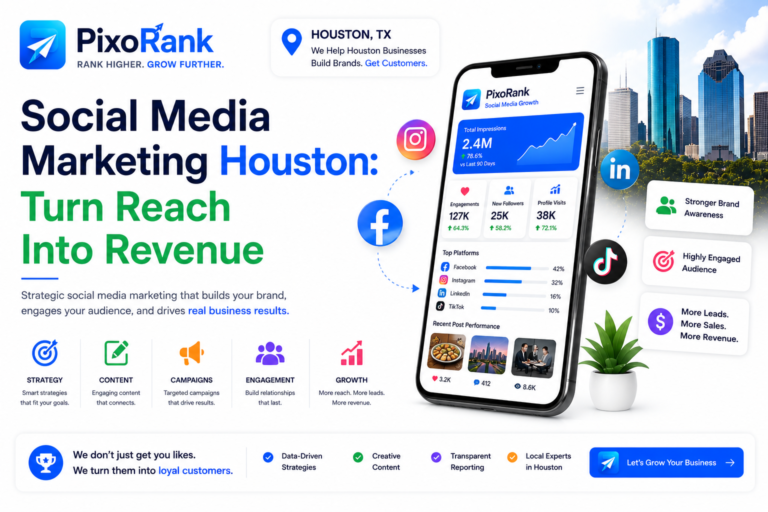
Likes and follower counts feel good, but they don’t pay the bills. Social media marketing houston campaigns should be judged by one standard: whether they actually turn reach into real leads, bookings, and sales. This guide covers what social media marketing genuinely involves, how it differs from day-to-day social media management, what a complete campaign should include, and how to choose an agency that measures success the same way you do.
Whether you’re comparing a social media marketing agency houston, searching social media marketing near me, or trying to understand what social media marketing services houston should actually deliver, this breaks it down clearly.
Social Media Marketing vs. Social Media Management
These two terms get used interchangeably, but they solve different problems. Social media management is the ongoing, day-to-day work of keeping accounts active — posting, responding to comments, and maintaining a consistent presence. Social media marketing is the strategic, growth-focused layer built on top of that: paid campaigns, audience targeting, and content built specifically to drive a measurable action.
Most businesses need both working together. A houston social media marketing company handling only paid campaigns without consistent organic management is building growth on an inconsistent foundation, while a business only managing day-to-day posting without any marketing strategy is missing the growth engine that turns a following into revenue.
Think of management as keeping the lights on and marketing as actively bringing in new customers. Both matter, but they answer different questions — management asks “are we present and responsive,” while marketing asks “are we actually growing.”
What a Complete Social Media Marketing Campaign Includes
A genuine social media marketing agency in houston should build campaigns around a specific business outcome, not just visibility for its own sake.
- Audience research and targeting based on who actually buys from you, not a generic demographic guess
- Platform-specific content built for how each audience actually behaves, not one asset reused everywhere
- Paid campaign management, including budget allocation and ongoing optimization
- Clear calls to action that guide viewers toward a specific next step
- Conversion tracking that ties campaign spend to actual leads and sales
A houston social media marketing services provider skipping conversion tracking is asking you to trust that a campaign is working without ever proving it.
Each of these pieces builds on the others. Strong targeting wasted on generic, unbranded content underperforms, just as excellent content aimed at the wrong audience fails to convert regardless of how well it’s made.
Choosing the Right Platforms for Your Business
Not every platform deserves equal investment. The right mix depends entirely on where your actual customers spend their time and how they make decisions.
Instagram and Facebook
Strong for visual, consumer-facing businesses — restaurants, retail, home services — where photos and short video build trust quickly.
TikTok
Effective for reaching younger audiences and building broad awareness quickly, though conversion often depends heavily on strong, native-feeling content rather than polished ads.
LinkedIn
The strongest platform for B2B social media marketing, where longer sales cycles and professional credibility matter more than visual appeal.
A social media marketing agency in houston worth hiring should recommend platforms based on your specific customers, not default to running the same mix for every client regardless of industry.
This is also where social media marketing houston campaigns tend to differ most from a generic national playbook — Houston’s size and neighborhood diversity mean audience behavior can vary meaningfully even within the same metro, let alone compared to a different city entirely.
It’s also worth resisting the pressure to be present everywhere at once. A business spread thin across five platforms with inconsistent effort on each typically underperforms one that concentrates budget and creative attention on the two or three platforms where its actual customers spend time.
The Real ROI of Social Media Marketing
Reach that actually converts
The chart above illustrates a common pattern: reach and conversion rate don’t always move together by platform. A channel with lower reach but higher intent can outperform a larger, less targeted audience.
A measurable, traceable customer journey
Paid social campaigns can be tracked from impression to click to conversion, giving a far clearer performance picture than most traditional advertising.
Compounding brand familiarity
Even campaigns that don’t convert immediately build recognition that supports future purchase decisions — someone who sees your brand repeatedly is more likely to choose it when they’re finally ready to buy.
Stronger performance across other channels
Well-run social campaigns often lift search interest and direct traffic too, since brand familiarity built on social media makes people more likely to search for your business by name.
This cross-channel effect is one of the more underappreciated benefits of social media marketing. A campaign that doesn’t convert directly on the platform can still be working — showing up later as a direct visit or a branded search a few days afterward.
What to Look for in a Social Media Marketing Agency
Whether you’re comparing social media marketing agencies near me or narrowing a shortlist of social media marketing companies near me, a few things separate a results-driven agency from one selling vanity metrics:
- They ask about your actual sales goals before proposing a platform mix
- They can explain their targeting strategy in specific, non-generic terms
- They report on conversions and cost per lead, not just reach and engagement
- They test and adjust creative regularly rather than running the same ad indefinitely
- They’re transparent about how much of your budget goes to ad spend versus management fees
It’s also worth understanding platform advertising policies directly. Meta’s advertising standards outline what’s allowed in paid campaigns across Facebook and Instagram.
Realistic Cost Expectations
Social media marketing costs include both the ad spend paid directly to each platform and the management fee charged by your agency. Ad spend varies by industry competitiveness and audience size, while management fees are typically a flat monthly rate or a percentage of spend.
A trustworthy social media marketing company near me should walk you through both pieces clearly and help set a realistic starting budget based on your specific goals, rather than a generic number applied to every client regardless of industry.
It also helps to think about cost relative to customer value. A campaign that costs more per lead but brings in higher-value customers can easily outperform a cheaper one generating volume without quality, which is why cost per lead alone rarely tells the full story.
Can I run social media marketing alongside SEO and PPC?
Yes, and many Houston businesses do. Social media marketing tends to build brand familiarity that supports both channels — someone who recognizes your brand from social media is more likely to click your ad or organic listing later.