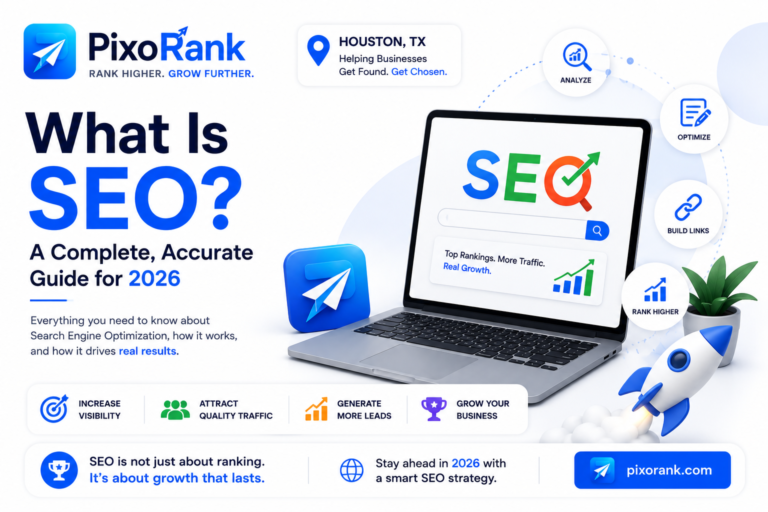
So, what is SEO, exactly? It’s the practice of improving a website so it ranks higher in unpaid search results — the process that determines whether your business shows up on the first page of Google or gets buried past where most people ever look. It combines technical website health, content quality, and off-site authority into one connected discipline.
This guide explains exactly how SEO works, the five main types of SEO, why it matters more than most people realize, and what separates an accurate understanding of SEO from the myths that still circulate about it.
Understanding what SEO is — genuinely, not just as a buzzword — is the first step toward using it well, whether you’re managing it yourself or evaluating a provider.
How Search Engines Actually Work
Search engines like Google use automated programs called crawlers to discover and read web pages. Pages that get crawled are then indexed — stored in a massive database — and evaluated against hundreds of signals to determine which results best answer a given search.
Answering what is SEO fully means understanding this chain: crawling, indexing, and ranking. A page that never gets crawled or indexed has no chance of ranking, no matter how well it’s written.
SEO is the work of making a website easy to crawl, clear to understand, and credible enough to rank well against that evaluation. None of this involves manipulating search engines directly — it means genuinely meeting the standards search engines use to identify useful, trustworthy pages.
The Five Types of SEO
SEO isn’t one single activity — it’s five connected disciplines, each addressing a different part of what makes a website rank well.
Technical SEO
The backend health of a website: page speed, mobile usability, crawlability, and clean site structure. Technical problems can quietly cap how well every other SEO effort performs.
On-Page SEO
Everything on an individual page that helps it rank and convert — titles, headings, content quality, internal links, and keyword relevance.
Off-Page SEO
Signals that happen outside your own website, most notably backlinks from other credible sites, which function as a vote of confidence in search engines’ evaluation.
Local SEO
Optimization specifically for location-based searches — Google’s map pack, “near me” queries, and neighborhood-level visibility for businesses serving a defined area.
Content SEO
The ongoing creation of content that genuinely answers what people are searching for, built around real search intent rather than just keyword placement.
A complete houston seo company should address all five areas together. Strength in one area rarely compensates for a significant weakness in another.
Knowing what SEO actually involves across these five areas also makes it much easier to evaluate a proposal from any provider — a plan touching only one or two of them is addressing a fraction of what SEO actually requires.
Why SEO Matters More Than Most Marketing Channels
- Organic search remains one of the largest sources of website traffic for most businesses
- Unlike paid ads, SEO visibility continues generating traffic without an ongoing per-click cost
- SEO builds compounding value — the chart above illustrates how organic value tends to grow over time, while paid visibility resets whenever spending stops
- People generally trust organic results more than they trust ads, which affects both clicks and conversion rates
This is why businesses working with a seo agency houston should think of SEO as a long-term asset rather than a short-term campaign with a defined end date.
Common SEO Myths, Corrected
Myth: SEO is just about keywords
Keywords matter, but modern SEO weighs technical health, content quality, and trust signals just as heavily. A page stuffed with keywords but weak everywhere else typically underperforms a well-rounded one.
Myth: More backlinks always means better rankings
Quality and relevance matter far more than volume. A handful of links from genuinely relevant, credible sources outperforms a large number of low-quality, unrelated ones.
Myth: SEO is a one-time task
Search engines continuously reassess content freshness and relevance, and competitors keep improving, which means SEO requires ongoing attention rather than a single setup.
Myth: Paid ads and SEO do the same thing
They solve different problems. Paid ads generate immediate, temporary visibility, while SEO builds lasting, compounding visibility that continues working after the initial investment.
How Long SEO Actually Takes
Most websites start seeing measurable improvements within 3 to 6 months, with stronger, more established results typically building over 9 to 12 months. Highly competitive industries or keywords generally take longer than niche or local terms with less competition.
Any seo services houston provider promising guaranteed rankings in a matter of days is describing something inconsistent with how search engines actually evaluate and rank websites.
SEO in the Age of AI Search
AI Overviews, ChatGPT, and other AI search tools now answer a meaningful share of searches directly, drawing on the same crawled, indexed content that traditional SEO has always relied on. This doesn’t replace SEO — it extends it, since a technically sound, well-structured website is easier for both search engines and AI tools to understand and cite accurately.
Google’s own documentation on how AI features use web content is a useful, accurate reference here — see Google’s guidance on AI features in Search for current technical detail.