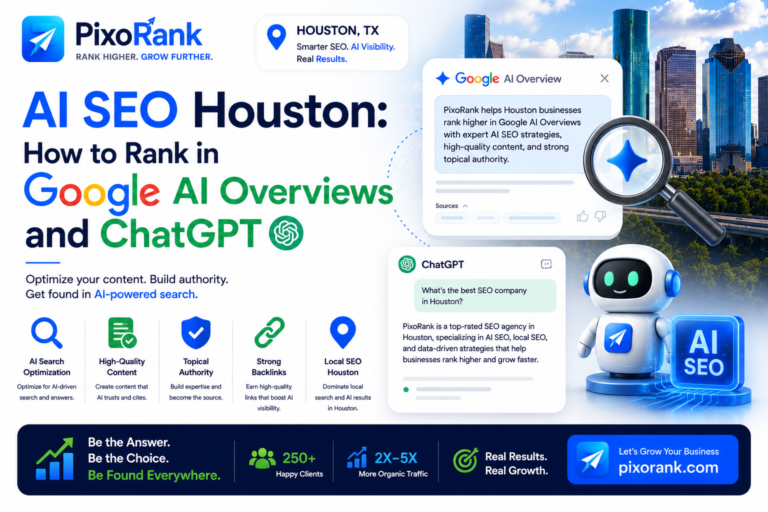
If you’ve noticed fewer clicks from Google even as your rankings hold steady, AI search is likely the reason. AI Overviews, Google’s AI Mode, ChatGPT, and Perplexity now answer many questions directly, often without sending a single click to a website. AI SEO Houston strategies exist for exactly this shift — making sure your business is the source these systems actually pull from and cite, not the one they leave out entirely.
PixoRank builds AI SEO Houston strategies that work alongside traditional SEO rather than replacing it, because the two are becoming more connected, not less. This guide explains what AI SEO actually involves, how AI search systems decide what to surface, and what a genuine AI SEO company in Houston should be doing for your business right now.
What Is AI SEO and Why Does It Matter for Houston Businesses?
AI SEO is the practice of optimizing your content so AI-powered search tools — Google AI Overviews and AI Mode, ChatGPT, Perplexity, and similar systems — can accurately understand, trust, and cite your business when answering a relevant question. It’s sometimes called answer engine optimization, or AEO, and it sits alongside traditional SEO rather than replacing it.
This matters because more people are starting their research inside an AI conversation instead of a traditional search box. A Houston business that only optimizes for the classic ten blue links risks becoming invisible in these newer experiences, even if its traditional rankings still look healthy. A dedicated AI SEO Houston approach makes sure your business shows up in both places, not just one.
How AI Search Engines and Chatbots Actually Choose Answers
Google has confirmed in its AI features and your website documentation that AI Overviews and AI Mode rely on the same underlying search index as traditional results, and that a page generally needs to already be eligible to appear in regular search — indexed, crawlable, and relevant — before it can be surfaced as a supporting source in an AI-generated answer. There’s no separate, secret ranking system to game.
Where AI search differs is in how it assembles an answer. Rather than returning one best-matching page, these systems often pull supporting details from multiple sources and synthesize them into a single response. That means a Houston business doesn’t need to “win” the single top spot to be included — it needs to be one of the clear, trustworthy sources an AI system can confidently draw from. This is exactly the opportunity a well-built AI SEO Houston strategy is designed to capture.
Structuring Content So AI Systems Can Understand and Cite It
Content that performs well for AI SEO tends to share a few traits: it answers a specific question directly and early, uses clear headings that match how people actually phrase their questions, and avoids burying the useful information under unnecessary preamble. This structure is the backbone of nearly every effective AI SEO Houston page we build.
Direct, Extractable Answers
AI systems favor content where the answer to a question is stated plainly, in a sentence or two, rather than implied across several paragraphs. Structuring key sections this way makes it far easier for an AI tool to lift an accurate, well-attributed answer straight from your page.
Clear Headings That Match Real Questions
Headings phrased the way people actually search — as questions, or close to them — help both traditional search engines and AI systems match your content to the right query. This is one of the simplest, highest-leverage habits behind effective content built for AI search visibility.
Building Topical Authority and Entity Recognition
AI systems, like traditional search engines, favor sources that demonstrate consistent, genuine expertise on a topic rather than a single page that happens to mention the right keywords. Covering a subject thoroughly across multiple connected pages helps establish your business as a recognizable, trustworthy entity in that space.
This kind of topical depth also helps AI systems disambiguate your business from similarly named competitors, which matters more than ever as these tools rely on entity recognition to decide who to cite by name. It’s a core part of any serious AI SEO Houston plan, since entity clarity compounds across every other tactic on this list.
Technical Foundations That Still Matter for AI Visibility
Google has been explicit that there are no special technical requirements to appear in AI Overviews or AI Mode beyond the fundamentals that already apply to traditional search: a page must be crawlable, properly indexed, and eligible to show a snippet in regular results. Skipping these basics rules a page out of AI visibility before content quality even becomes a factor.
That means fast load times, mobile usability, clean site structure, and accessible robots.txt settings aren’t just legacy SEO tasks — they’re prerequisites for AI SEO too. A Houston business investing heavily in AI-focused content while ignoring technical fundamentals is building an AI SEO Houston strategy on an unstable foundation.
Answer Engine Optimization for FAQs and Voice Search
FAQ-style content is particularly well suited to AI SEO because it already mirrors how people phrase questions to AI assistants and voice search. A well-structured FAQ section gives AI systems a ready-made, clearly attributed answer to lift, rather than making them infer one from dense paragraphs.
This same structure benefits voice search results, since spoken queries tend to be phrased as natural questions rather than short keyword strings. Businesses that build genuine AEO into their content as part of a broader AI SEO Houston strategy are positioning themselves for both the AI chat experience and the voice assistant one.
Measuring AI SEO Results
AI SEO results look different from a traditional rankings report, since there’s no single “position one” to track in a conversational AI answer. Instead, meaningful measurement looks at whether your business is being mentioned or cited in AI-generated responses for relevant questions, alongside traditional organic visibility, traffic, and lead metrics that still matter just as much as before.
Ongoing reporting should show both sides of the picture — how you’re performing in classic search results and how visible you are within AI-generated answers — so you can see the complete return on your AI SEO Houston investment rather than a partial one.
How to Choose an AI SEO Company in Houston
Treat any promise of guaranteed placement inside ChatGPT or Google’s AI Overviews with skepticism, since no agency controls what a third-party AI system chooses to cite. Look instead for a Houston AI SEO company that’s transparent about this reality and focuses on the things that are actually within their control: technical health, content structure, and topical authority.
An AI SEO Houston partner should also understand that this work doesn’t replace traditional SEO — it builds on it. PixoRank treats AI SEO as one layer of a complete search strategy rather than a stand-alone service sold separately from the fundamentals that still drive most of your traffic today.
Conclusion
AI SEO isn’t a separate discipline from the SEO Houston businesses have relied on for years — it’s an extension of it, built for a search landscape where AI-generated answers increasingly sit alongside, or in place of, a traditional list of links. Getting the fundamentals right still matters more than ever, because eligibility for AI visibility starts with the same crawlability, indexing, and content quality that’s always driven traditional rankings.
If you want an AI SEO Houston strategy that treats this shift as an extension of solid SEO rather than a trend to chase separately, PixoRank is ready to help you build one.