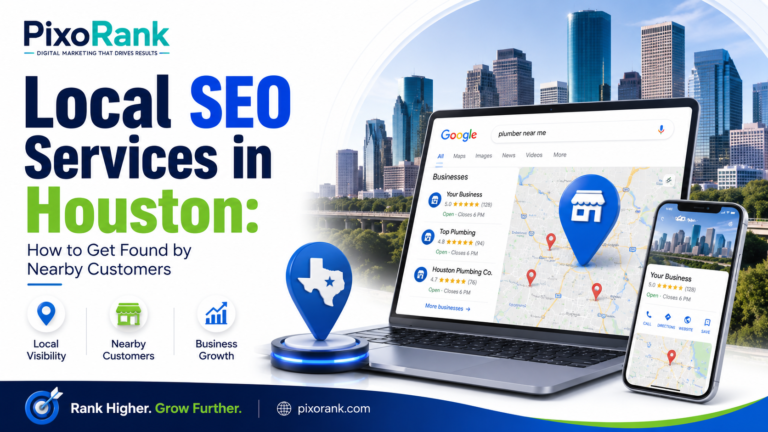
If you run a business that depends on customers finding you nearby — a clinic, a law firm, a home services company, a restaurant — local SEO services in Houston are usually the fastest path to more calls, more visits, and more revenue from search. Most people don’t scroll past the map pack and the first few organic results, so if your business isn’t showing up there, a competitor down the street probably is.
This guide walks through what local SEO services in Houston actually include, how they differ from broader SEO work, and what to look for when choosing a provider. Whether you’ve been searching for “local SEO Houston,” “Houston local SEO company,” or simply “local SEO near me,” the fundamentals below apply.
What Are Local SEO Services in Houston?
This kind of service focuses on making your business visible when nearby customers search for what you offer — in Google’s map pack, in local organic results, and in “near me” searches on mobile devices. This is different from ranking nationally; it’s about owning visibility within the specific neighborhoods and suburbs you actually serve.
For a city as large and spread out as Houston, this distinction matters. A business in the Heights and a business in Sugar Land are technically in the same metro area, but they’re competing in very different local search landscapes.
Why Local SEO Matters More Than Ever for Houston Businesses
A large share of searches on mobile devices carry local intent — people looking for a business “near me” or in a specific part of town, often ready to visit or call the same day. For a Houston business, that means the difference between showing up in the map pack and not showing up at all can directly affect foot traffic and phone calls.
Houston’s size also works in your favor once you’re set up correctly. A business that ranks well for local SEO Houston searches in its specific service area faces a smaller, more relevant pool of competitors than one trying to rank for broad national terms.
Local SEO vs. Traditional SEO: What’s the Difference?
Business owners often ask a Houston local SEO company how this work differs from general SEO. The two overlap, but the focus is not identical.
Traditional SEO
Traditional SEO aims to rank a website broadly, regardless of the searcher’s location. This approach fits businesses that sell online, ship nationally, or serve clients remotely.
Local SEO
Local SEO narrows that focus to a defined service area, prioritizing map pack visibility, local organic rankings, and location-based search intent. For most Houston small businesses — especially those with a physical location or a defined service radius — local SEO should carry the bulk of the strategy, since that’s where most buying decisions actually start.
A well-rounded provider blends both approaches based on how your business generates revenue, rather than applying a one-size-fits-all plan.
How to Choose a Provider for Local SEO in Houston
Not every agency offering local SEO services in Houston approaches the work the same way. A few questions can help separate a strong partner from a wasted budget.
Do They Show You Real Data?
A trustworthy provider should share rankings, map pack visibility, and lead trends on a recurring basis, in terms you can actually follow — not just a dashboard full of jargon.
Are Their Timelines Realistic?
Local SEO moves faster than some other SEO work, but it still isn’t instant. Meaningful map pack movement typically takes a few months, and steady improvement builds from there.
Do They Understand Your Service Area?
A provider working on this kind of campaign should be able to speak specifically about your neighborhoods, suburbs, and local competitors — not just general SEO theory.
What Results Should You Expect?
Results vary by industry and starting point, but a well-run local SEO engagement should generally move these in the right direction over time:
- Map pack visibility — appearing in the top local results for relevant searches
- Google Business Profile engagement — more calls, clicks, and direction requests
- Local organic rankings — stronger positions for neighborhood and service-area terms
- Review volume and quality — a growing base of recent, positive reviews
No honest provider can guarantee specific rankings, since search engines — not agencies — control final placement. Google’s own guidance on local ranking factors is a useful reference point for understanding how this actually works.
Local SEO and the Rise of AI-Powered Search
As AI-driven search tools and answer engines become part of how people find nearby businesses, the fundamentals of local SEO — accurate listings, clear location signals, and genuine reviews — matter just as much as before. A good local SEO partner should be thinking about how your business shows up across both traditional search and newer AI-assisted discovery, without abandoning the basics that still drive most local visibility.
Local SEO on Its Own or as Part of a Bigger Strategy?
Some Houston businesses only need focused local SEO services to strengthen map pack and nearby search visibility. Others benefit from pairing it with broader SEO, PPC, or social media marketing under one digital marketing agency in Houston, especially if they’re trying to build visibility both locally and beyond the metro area.
Local SEO for Different Types of Houston Businesses
Local search behavior looks a little different depending on your industry, and a strong strategy accounts for that rather than applying the same playbook to every business type.
- Healthcare and dental practices often compete on trust signals — reviews, credentials, and clear location and insurance information — since patients typically choose a nearby provider they feel confident about before booking.
- Legal services tend to see longer research periods before a call, so local content that answers specific questions tied to practice areas and Houston-area courts can build credibility ahead of that first contact.
- Home services businesses — plumbers, electricians, HVAC companies, roofers — usually see the most direct return from map pack visibility, since these searches often come from someone who needs help quickly and is ready to call.
- Restaurants and retail locations benefit heavily from photos, hours accuracy, and review volume, since these details influence same-day decisions more than almost any other local business type.
Understanding where your industry fits helps prioritize which parts of a local SEO strategy matter most for your specific goals.
Either way, the right starting point is a clear look at where your business currently shows up — and where your customers are actually searching from.
Common Local SEO Mistakes Houston Businesses Make
Even businesses that invest in local SEO can undercut their own results with a few avoidable habits.
- Inconsistent business information. Mismatched names, addresses, or phone numbers across directories confuse both customers and search engines.
- Ignoring reviews. Not responding to reviews, or having too few recent ones, weakens both trust and local ranking signals.
- Treating it as a one-time project. Local search results shift as competitors update their own listings and content, so ongoing attention matters.
- Using generic content. Pages that never mention specific neighborhoods, landmarks, or service areas miss an easy local relevance signal.
Addressing these basics often produces noticeable improvement before more advanced work even begins.