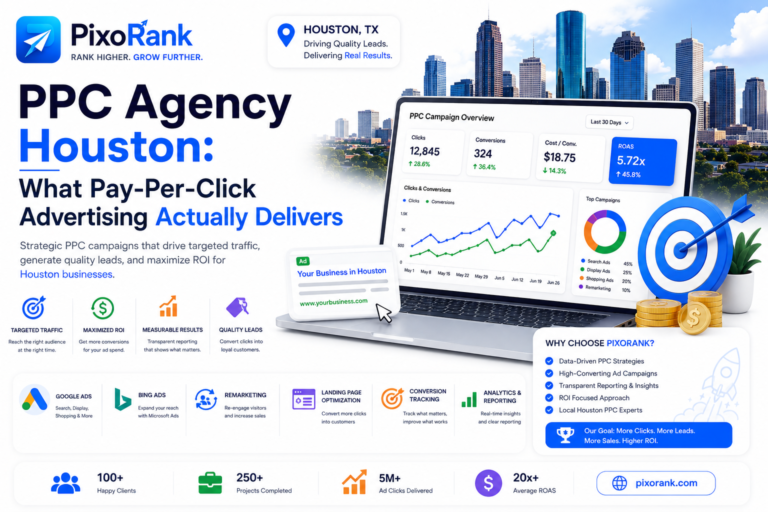
Pay-per-click advertising is the fastest way to put your business in front of Houston customers who are actively searching right now — not next month, not after months of building organic rankings, but today. A ppc agency houston businesses trust should turn that speed into real leads and sales, not just clicks that never convert.
This guide covers what PPC actually is, what a complete campaign should include, and what separates a well-run account from one quietly burning through budget with little to show for it.
What PPC Actually Is, in Plain Terms
Pay-per-click advertising places your business at the top of search results — above organic listings — for keywords you choose, and you pay only when someone actually clicks. Unlike SEO, which builds visibility gradually, PPC can generate traffic and leads within hours of a campaign going live.
This makes a houston ppc agency a natural fit for businesses that need visibility now — a new business without organic rankings yet, a seasonal promotion, or a service business trying to fill a slow week. It’s also a useful complement to SEO for established businesses that want guaranteed top placement alongside their organic results.
The tradeoff is straightforward: PPC delivers speed, while SEO delivers durability. Understanding which one your business needs most right now — or whether you need both — is the first real decision in any PPC conversation.
What a Complete PPC Campaign Should Include
Not every ppc agency in houston scopes campaigns the same way. A complete engagement typically includes:
- Keyword research focused on high-intent, commercially relevant search terms
- Campaign structure organized by service, location, or product for cleaner reporting
- Compelling ad copy tested and refined over time, not written once and left alone
- Landing pages built specifically to convert the traffic each ad sends
- Ongoing bid management and budget optimization based on actual performance
- Conversion tracking tied to real outcomes — calls, form fills, and sales
A provider offering only ad creation without landing page strategy or conversion tracking is delivering a fraction of what a genuine ppc management company should provide.
Each of these pieces affects the others. A perfectly targeted ad sending traffic to a slow, generic landing page wastes much of the value that targeting created, which is why campaigns should be evaluated as one connected system rather than isolated parts.
The Real Benefits of PPC Advertising
Immediate visibility, no waiting
Unlike SEO, which takes months to build authority, a well-structured PPC campaign can start generating clicks and leads the same day it launches.
Precise targeting
PPC lets you control exactly who sees your ads — by location, time of day, device, and search intent — so budget goes toward the people most likely to actually become customers.
Fully measurable return
Every dollar spent can be traced to a click, a lead, and often a sale, giving PPC one of the clearest return-on-investment pictures of any marketing channel.
Flexibility to scale up or down
Budget can be adjusted immediately based on results or business needs, without the long lead time required to scale an SEO or content strategy.
PPC and SEO Work Better Together Than Alone
PPC and SEO solve different problems. PPC delivers immediate visibility but stops the moment spending stops. SEO builds a lasting foundation but takes months to mature. Businesses that run both tend to outperform those relying on either channel alone.
A capable houston seo company running PPC alongside organic SEO can also use paid search data — which keywords actually convert — to sharpen the content and local SEO strategy, creating a feedback loop that improves both channels over time.
This is one of the most underused advantages of running both channels together. PPC data reveals exactly which keywords convert into real leads, well before that same insight would show up organically, giving SEO a head start on where to focus.
Which Houston Businesses Benefit Most From PPC
- New businesses that need visibility before organic rankings have time to build
- Service businesses with urgent, high-intent searches like plumbing or legal help
- Businesses running seasonal promotions or time-sensitive offers
- Companies testing new markets, services, or locations before committing further budget
If your business fits any of these situations, working with ppc agencies in houston that understand your specific goals is likely to produce a measurable, fast return.
What to Look for in a PPC Management Company
Whether you’re comparing a ppc company near me or narrowing down a shortlist of ppc companies near me, a few things separate a strong provider from a weak one:
- They start with a clear conversation about your goals and target customer, not just a budget number
- They build dedicated landing pages rather than sending traffic to a generic homepage
- They report on leads and conversions, not just clicks and impressions
- They actively manage and adjust campaigns rather than setting them and walking away
- They’re transparent about how much of your budget goes to ad spend versus management fees
A ppc management company near me worth hiring should be able to explain exactly how they’ll turn your budget into measurable business results, not just “more traffic.”
It’s also worth asking how often campaigns are reviewed and adjusted. PPC performance shifts with competition, seasonality, and platform changes, so an account left untouched after launch tends to become less efficient over time, even if it performed well initially.
Realistic Cost Expectations for PPC
PPC costs include two separate pieces: the ad spend itself, paid directly to the platform, and the management fee charged by your agency. Ad spend varies widely by industry and competition, while management fees are typically either a flat monthly rate or a percentage of ad spend.
A trustworthy provider should walk you through both pieces clearly, and help you set a realistic starting budget based on your industry’s competitiveness rather than an arbitrary number picked in advance.
Be cautious of any pricing model that isn’t clearly explained upfront. A management fee structured as a percentage of spend should scale sensibly with your budget, not create an incentive to simply increase spend without a corresponding increase in results.